
A smaller dog does not automatically equal an easy flat dog. That distinction matters when prospective owners consider a miniature labradoodle because size is only one part of everyday compatibility.
Labradoodle crosses can inherit an active, sociable nature from both Labrador and Poodle ancestry. A flat or terraced house can still work extremely well, but success depends much more on routine, training and access to outdoor exercise than on the number of rooms in the property.
Dogs do not spend their day measuring square metres.
What matters is whether they have a comfortable place to rest, regular opportunities to toilet, daily exercise and enough mental activity to avoid boredom.
PDSA notes that dogs can live successfully in many different environments, including flats, provided their welfare needs are met. A garden can be useful, but it does not replace walks outside the home.
A compact home with an organised routine may therefore work better than a large house where the dog rarely goes anywhere.
The word miniature can create unrealistic expectations.
Crossbreeds do not always mature to an exact predicted size, and two puppies from the same type of cross may grow differently. Prospective owners should therefore ask about both parents rather than assuming the adult dog will fit a particular weight or height.
More importantly, smaller stature does not remove the need for exercise.
PDSA explains that exercise requirements depend on breed, age, health, fitness and personality. Many medium-sized dogs need considerable daily activity, often spread across more than one walk.
A secure garden makes quick toilet trips easier, particularly during puppyhood.
For a terraced-house owner, even a modest outdoor area can be valuable. It gives the dog somewhere to step outside without turning every toilet break into a walk around the block.
What it cannot do is replace exploration.
Dogs benefit from sniffing new environments, encountering different sights and practising calm behaviour around the outside world. Walking provides mental stimulation as well as physical exercise.
The practical reality changes when you live several floors above ground.
A young puppy cannot simply wait for two scheduled walks each day. Frequent toilet opportunities are part of early training, which can mean repeated trips downstairs during the first months.
Think about the route before bringing a puppy home.
Is there a lift? How far is the nearest appropriate outdoor area? Can you make that journey late at night or early in the morning?
These details matter more in daily life than whether the sitting room is large.
Terraced houses and flats usually mean closer neighbours.
An excited dog barking whenever someone enters the communal hallway can quickly become a source of tension. The same is true of whining when left alone.
Training should begin before noise becomes an established habit.
Reward calm responses to door sounds, footsteps and visitors. Build alone time gradually rather than expecting a puppy to cope immediately with several hours by itself.
PDSA recommends avoiding leaving dogs alone for prolonged periods and suggests that they should generally not be left for longer than around four hours.
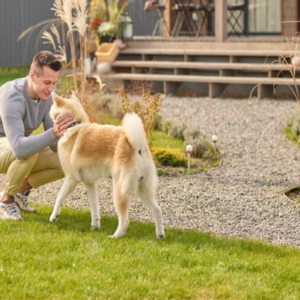
A walk is important, but an intelligent dog may still return home looking for something to do.
Short training sessions, food puzzles, scent games and controlled play can provide useful mental work without needing a huge indoor area.
This is particularly helpful on days when weather limits longer outdoor activities.
It also means owners should not rely on exhausting a dog physically every day. Teaching the dog how to settle is equally valuable in a smaller property.
More exercise is not always better, particularly for a growing puppy.
PDSA warns against excessive high-impact activity while joints and growth plates are still developing. Walks should build gradually, with play, training and age-appropriate exploration forming part of the routine.
That makes puppy ownership in a flat less about kilometre targets and more about regular, manageable experiences.
A miniature labradoodle does not necessarily need a detached house and a huge lawn.
What the dog does need is reliable access outside, meaningful daily walks, training, company and enough mental stimulation to cope calmly indoors.
For flat and terraced-house owners, the bigger questions are practical ones: how quickly can you reach an outdoor toilet area, how much time can you give to exercise, and how well can you manage noise around neighbours?
If those parts of the routine work, limited garden space does not have to prevent a miniature Labradoodle from living comfortably in a smaller UK home.